
In the complex landscape of industrial manufacturing, the acquisition of an Enterprise Resource Planning (ERP) ecosystem is a foundational strategic capital deployment. For the Investment Committee and C-Suite, the objective extends beyond operational visibility; it requires a rigorous validation of the Total Cost of Ownership (TCO), the scalability of multi-year licensing agreements, and the potential to leverage digital assets for competitive commercial financing.
This executive report analyzes the financial architecture of ERP procurement. We examine the structural shift from depreciating legacy hardware to agile Cloud SaaS subscription models, evaluating how this transition optimizes working capital, reduces audit exposure, and aligns with cyber liability insurance mandates.
Financial Engineering & Audit Integrity
An enterprise-grade ERP functions as the “single source of truth” for corporate financial planning and analysis (FP&A). It consolidates fragmented data streams—Procurement, HR, Supply Chain, and Treasury—into a unified centralized ledger. This integration is a prerequisite for maintaining regulatory compliance (SOX, GDPR, ISO 27001), streamlining external audit advisories, and ensuring granular visibility into Cost of Goods Sold (COGS).
Advanced ERP architectures facilitate real-time standard costing and variance analysis. By automating these internal controls, manufacturers can demonstrate audit trail integrity to lenders, thereby improving their credit profile for commercial loans and reducing the organizational cost of capital.
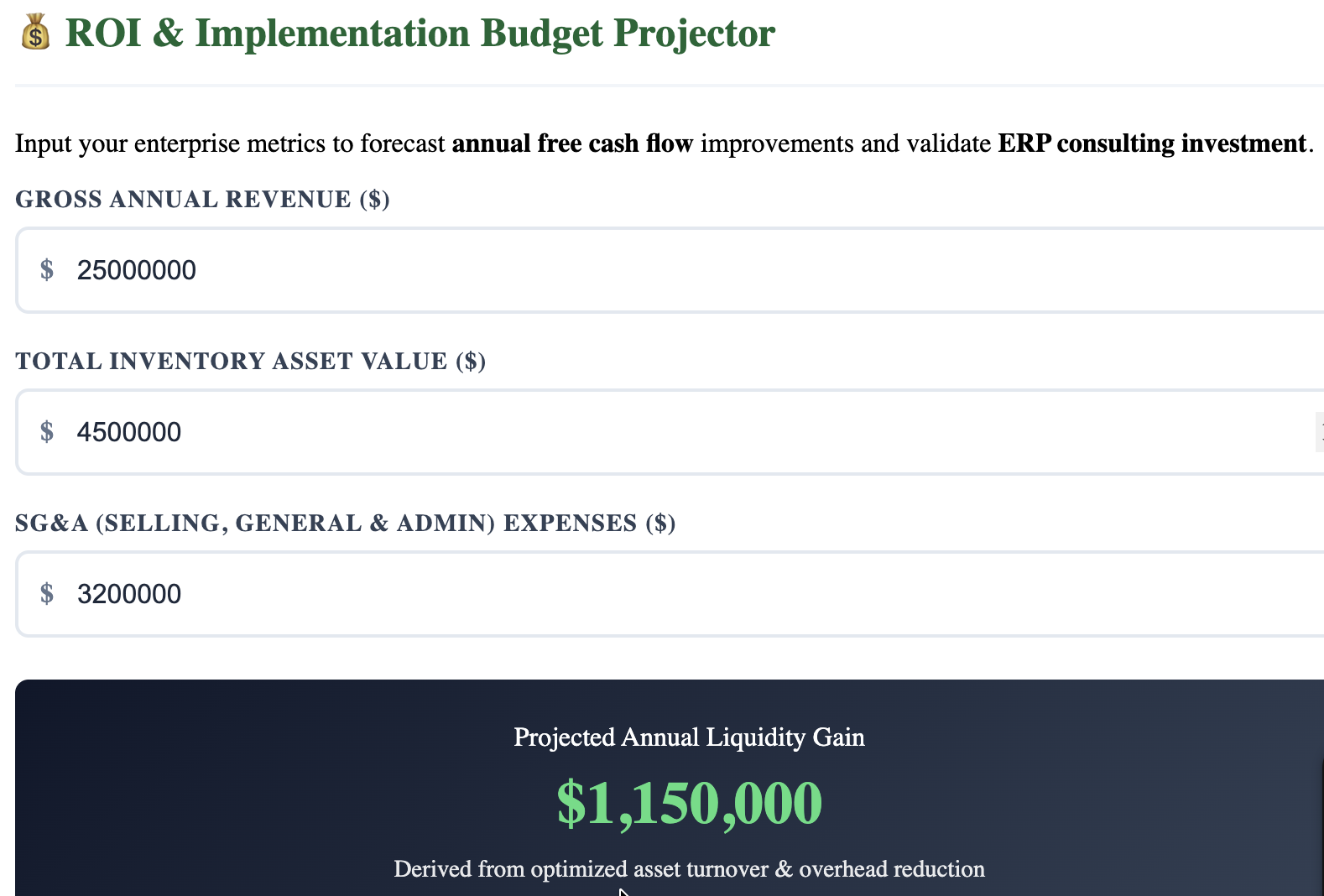
💰 ROI & Implementation Budget Projector
Input your enterprise metrics to forecast annual free cash flow improvements and validate ERP consulting investment.
*Estimates based on Tier-1 banking benchmarks for digital transformation ROI. Actual SaaS licensing fees and implementation scope will vary.
CapEx vs. OpEx: The Procurement Dilemma
The decision between on-premise infrastructure and cloud solutions is fundamentally a balance sheet management strategy. Understanding the nuances of ERP pricing models is vital for accurate long-term budgeting.
- Legacy On-Premise (CapEx): Requires substantial upfront capital for server hardware, data center cooling, and perpetual licensing. While this offers control, it locks up cash, involves complex depreciation schedules, and incurs hidden maintenance costs.
- Cloud SaaS (OpEx): The dominant model for agile enterprises. Subscription-based pricing covers hosting, security patches, and disaster recovery. This preserves credit lines for strategic initiatives and simplifies tax treatment as a direct, deductible operating expense.
High-Yield Modules for Profit Maximization
To justify the ERP implementation budget, the system must deliver tangible Internal Rate of Return (IRR) across key profit centers.
- Treasury & Risk Management: Automates cash positioning and ensures compliance with IFRS/GAAP standards. Essential for multinational entities managing currency risk and intercompany settlements.
- Supply Chain Finance (SCF): Integrates procurement with trade finance platforms, optimizing payment terms, dynamic discounting, and working capital cycles.
- Inventory Optimization (WMS): Utilizes AI to predict demand, reducing capital trapped in safety stock. This directly lowers warehouse insurance premiums and inventory write-downs.
- Human Capital Management (HCM): Aligns workforce planning with production forecasts, ensuring labor costs remain within departmental budgets and facilitating accurate payroll compliance.
Vendor Selection & System Integration
Selecting a partner requires rigorous vendor due diligence regarding Service Level Agreements (SLAs) and the capabilities of their System Integrator (SI) network.
- SAP S/4HANA: The gold standard for global conglomerates requiring complex intercompany consolidation and tiered supply chains. High initial cost, but unmatched depth for comprehensive digital transformation.
- Oracle NetSuite: The premier Cloud ERP for mid-market growth. Offers rapid time-to-value and a scalable subscription structure ideal for pre-IPO firms preparing for public scrutiny.
- Microsoft Dynamics 365: Leverages the Azure stack for seamless integration with corporate productivity tools (Power BI, Excel), effectively reducing the learning curve and change management costs.
ROI & Risk Mitigation: The Business Case
Final approval from the Board hinges on demonstrating risk-adjusted returns. The value proposition extends beyond efficiency into corporate resilience and valuation defense.
Credit Risk & Cash Flow Predictability
Modern ERPs utilize predictive analytics to assess customer creditworthiness and automate collections. This reduces Day Sales Outstanding (DSO) and minimizes bad debt exposure, a key metric scrutinized by external credit rating agencies and lenders.
Case Study: Aerospace Capital Efficiency
Boeing’s Digital Transformation:
By unifying operations on a centralized ERP backbone, Boeing achieved a documented 20% reduction in inventory holding costs. This released millions in free cash flow and improved delivery reliability, directly impacting revenue recognition timelines and shareholder value.
“Investing in intelligent ERP infrastructure is not merely an IT upgrade; it is a strategic hedge against market volatility, a requirement for cyber insurance eligibility, and a catalyst for sustainable valuation growth.”
Future Trends: ESG & Embedded Finance
The next frontier of manufacturing ERP integrates sustainability reporting and automated finance.
- ESG Compliance: Automated carbon footprint tracking will become essential for accessing green bonds and favorable investment capital from institutional investors.
- Embedded Banking: APIs will allow direct connectivity with banking partners for real-time payments and automated reconciliation, reducing transaction fees.
- Cybersecurity Assurance: Robust ERP security protocols are now a prerequisite for obtaining comprehensive cyber liability insurance and passing third-party vendor risk assessments.
Conclusion
The transition to a robust ERP ecosystem is a defining moment for enterprise maturity. It converts data into a strategic asset, enabling precise capital allocation. By carefully evaluating financing options, validating Cloud ERP pricing, and partnering with experienced ERP consultants, organizations secure their competitive advantage in a complex global economy.